About
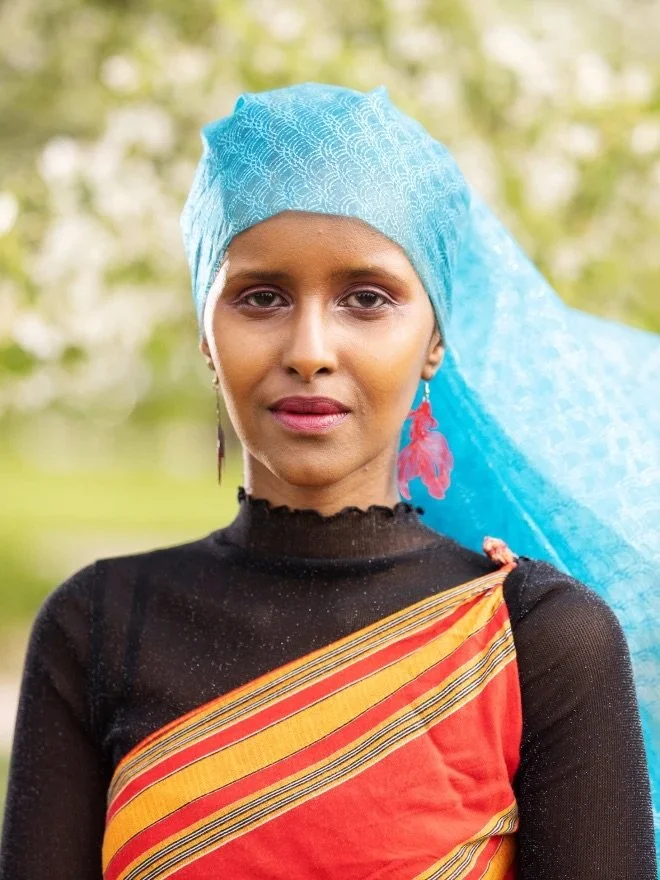
Ifrah Mansour is an award-winning Somali refugee Muslim multimedia artist, self-taught Indigenous weaver, archivist, and educator based in Minnesota. Working across sculpture, installation, performance, film, puppetry, textiles, and written forms, she creates place-based works exploring memory, migration, ecological care, and collective healing. Through performance, installation, and participatory art-making, Mansour creates architectures of empathy that reconnect people to memory, land, and one another.
Before the age of ten, Mansour lived through civil war, famine, drought, and refugee camps. Her grandmother’s oral storytelling became her first artistic inheritance, shaping a practice grounded in imagination as survival, resistance, and renewal. Today, her work transforms lived experiences of displacement into spaces of belonging and repair.
Her acclaimed theatrical work “How to Have Fun in a Civil War” tells the story of the Somali civil war through the eyes of a child, while “I Am a Refugee” explores the tenderness and contradictions of identity and home. Across projects including “Healing Aqal”, “Birds of Peace” “Halima Smile” and “Weaving Abundance”, she combines ancestral Somali knowledge with participatory art-making and ecological material transformation.
Mansour’s work has been presented internationally and featured in the The New York Times, BBC, VICE, Hyperallergic, and the Star Tribune. Her practice has been supported through John F. Kennedy Center for the Performing Arts, Bush Foundation, Jerome Foundation, Georgetown University’s Laboratory for Global Performance and Politics, and the McKnight Foundation